Tinggalkan Pesan
Jika anda berminat dengan produk kami dan ingin mengetahui lebih lanjut, sila tinggalkan pesanan di sini, kami akan membalas anda secepat mungkin.

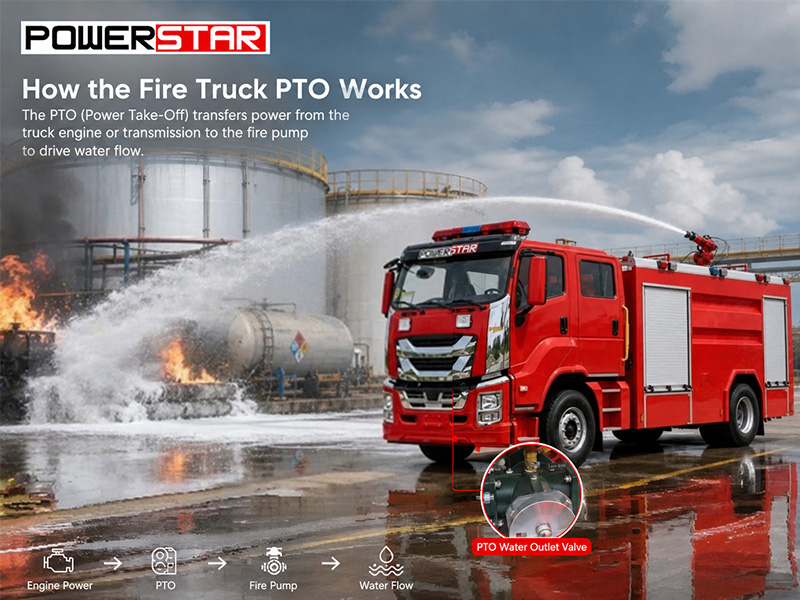
PTO (Power Take-Off) trak bomba pemadam kebakaran ialah peranti penghantaran kuasa yang memindahkan kuasa enjin ke pam bomba. Apabila anggota bomba mengaktifkan PTO, kuasa mekanikal daripada enjin dihantar melalui transmisi dan PTO ke pam bomba — ini ialah prinsip kerja teras bagaimana sebuah trak pemadam kebakaran sistem PTO beroperasi — membolehkan pam menyalurkan air atau buih bertekanan tinggi dan kadar aliran tinggi tanpa memerlukan enjin tambahan berasingan.
Trak bomba moden biasanya menggunakan sistem PTO dipasang sisi atau sistem PTO kuasa penuh. Sistem ini menawarkan keluaran kuasa yang stabil, operasi yang mudah, dan kos penyelenggaraan yang rendah, menjadikannya komponen penting dalam sistem pemadaman kebakaran trak bomba.
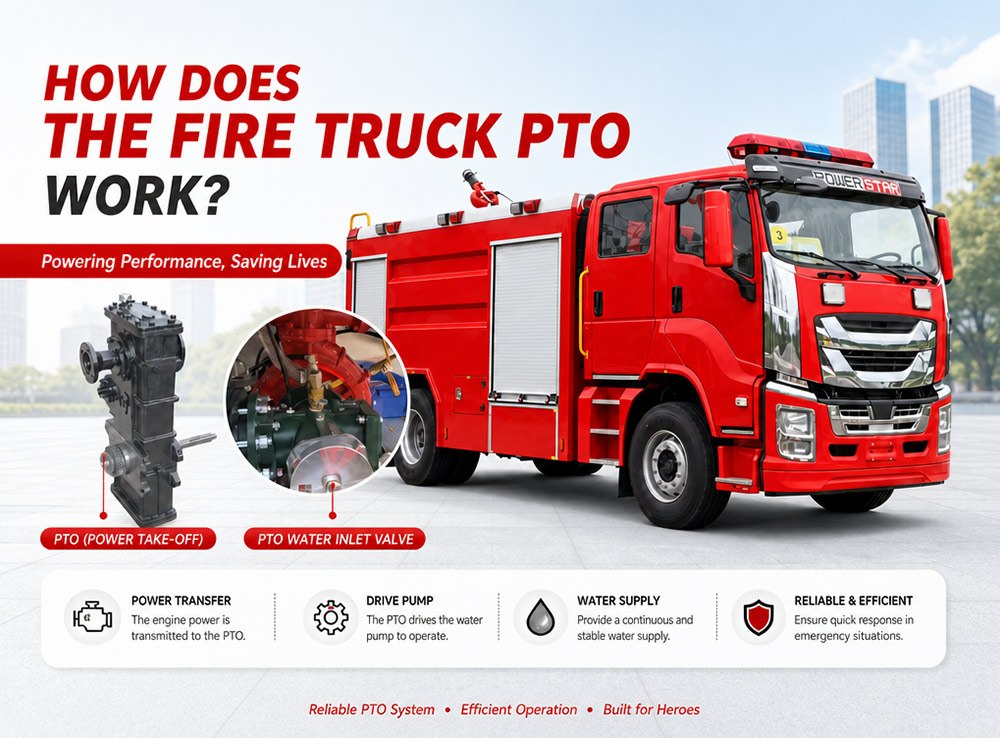
PTO (Power Take-Off) ialah komponen penting dalam sistem kuasa trak bomba. Ia ialah peranti penghantaran gear yang dipasang antara enjin dan transmisi, direka untuk "mengalihkan" sebahagian kuasa mekanikal daripada enjin atau transmisi kenderaan ke pam bomba atau peralatan tambahan lain, tanpa menjejaskan keupayaan pemanduan normal kenderaan.
Enjin trak bomba pada asalnya hanya bertanggungjawab untuk memacu roda. Walau bagaimanapun, apabila trak bomba tiba di lokasi kebakaran, roda tidak lagi memerlukan kuasa, manakala pam bomba memerlukan kuasa untuk menyedut dan memberi tekanan kepada air. PTO ialah peranti yang melaksanakan "pertukaran kuasa" ini.
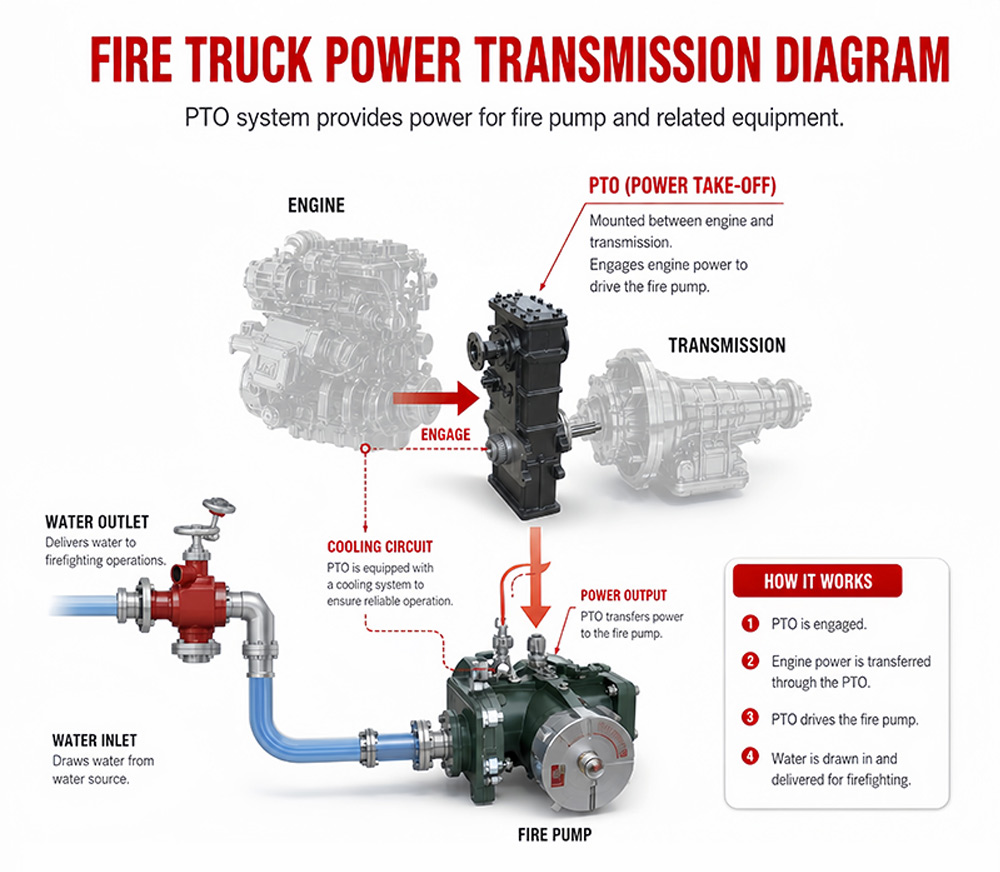
Power Take-Off (PTO) secara harfiah bermaksud "peranti keluaran kuasa".
Pada trak bomba, ia merujuk kepada pengambilan kuasa putaran daripada roda tenaga enjin atau gear transmisi melalui penyambungan gear, dan menghantarnya ke pam bomba atau peralatan tambahan lain.
Namanya menerangkan fungsinya:
Enjin = Sumber kuasa
PTO = Pengagih kuasa
Pam bomba = Bahagian penggunaan kuasa
Oleh itu, PTO ialah jambatan yang menghubungkan "sumber kuasa" dan "sistem pemadaman kebakaran".
Sebab utama trak bomba mesti dilengkapi dengan PTO ialah operasi pemadaman kebakaran memerlukan keluaran kuasa tinggi yang berterusan dan stabil, yang tidak boleh bergantung pada keadaan pemanduan kenderaan.
Sebab utama:
1. Menyediakan kuasa pemadaman kebakaran berterusan
Pam bomba perlu beroperasi untuk tempoh yang panjang semasa operasi pemadaman kebakaran. PTO membolehkan enjin terus memacu pam bomba pada kelajuan melahu atau RPM tetap, memastikan tekanan air dan aliran yang stabil.
2. Meningkatkan kecekapan penggunaan kuasa
Tanpa PTO, enjin tambahan berasingan diperlukan untuk memacu pam bomba, yang akan meningkatkan:
Kos
Kerumitan penyelenggaraan
Risiko kegagalan
Penggunaan ruang
PTO menggunakan kuasa enjin kenderaan secara langsung, meningkatkan kecekapan keseluruhan.
3. Menyokong pelbagai sistem pemadaman kebakaran
Trak bomba industri moden mungkin merangkumi bukan sahaja pam air tetapi juga:
Sistem buih
Sistem serbuk kering
Sistem air bertekanan tinggi
Monitor kebakaran kawalan jauh
Tanpa PTO, hanya terdapat dua penyelesaian:
Pasang enjin berasingan untuk memacu pam → meningkatkan berat, kos, titik penyelenggaraan, dan menggunakan ruang
Pastikan pam sentiasa disambungkan secara kekal kepada transmisi → pam berhenti apabila kenderaan berhenti, tidak dapat mengepam air di lokasi
PTO menyelesaikan kedua-dua masalah sekali gus:
| Mod | Status PTO | Destinasi kuasa | Hasil |
| Mod pemanduan | Dinyahdayakan | Semua ke roda | Pemanduan normal |
| Mod memadam kebakaran | Diaktifkan | Semua ke pam kebakaran | Mengepam ketika tidak bergerak |
PTO pada asasnya ialah "sistem pengagihan dan penukaran kuasa" yang mengubah kuasa pemanduan kenderaan menjadi kuasa operasi memadam kebakaran.
Dari perspektif kejuruteraan, laluan kuasa lengkap ialah:
Enjin → Transmisi → PTO → Aci Pemacu → Pam Kebakaran → Monitor Kebakaran/Sistem Hos
Prinsip kerja PTO boleh diringkaskan dalam tiga peringkat utama: pengambilan kuasa, penglibatan, dan penghantaran.
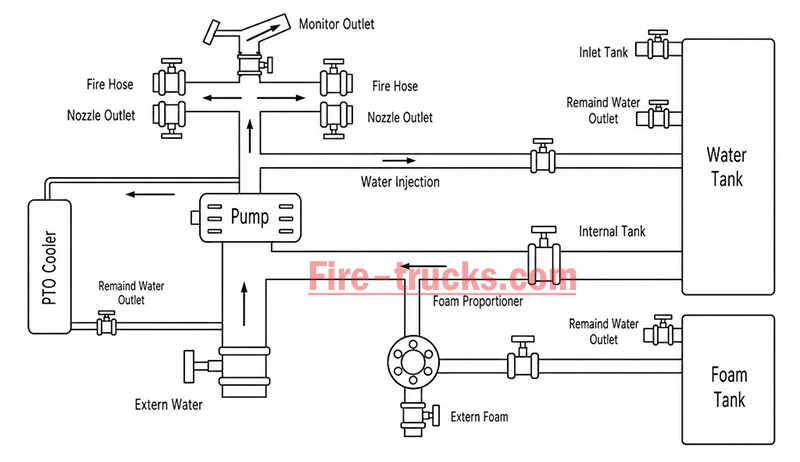
PTO mengambil kuasa daripada enjin. Bergantung pada kedudukan pemasangan, kaedah pengambilan kuasa berbeza:
| Jenis PTO | Kedudukan Pemasangan | Sumber Kuasa | Ciri-ciri |
| PTO dipasang di sisi | Bahagian transmisi | Gear aci lawan transmisi | Struktur ringkas, kuasa lebih rendah (≤50% kuasa enjin) |
| PTO sandwic | Di antara enjin dan transmisi | Roda tenaga enjin | Output kuasa penuh, konfigurasi utama |
| PTO aci pisah | Di antara transmisi dan aci pemacu | Aci keluaran transmisi | Kuasa tinggi, membolehkan pengepaman semasa memandu |
Selepas pemandu menekan suis PTO dalam kabin, mekanisme penggandingan diaktifkan:
| Kaedah Penggandingan | Prinsip Kerja | Biasa Digunakan Pada |
| Kawalan solenoid elektrik | Isyarat elektrik mengaktifkan solenoid, menolak garpu penukar | Digunakan secara meluas pada jentera bomba moden |
| Kawalan pneumatik | Udara termampat menolak omboh, menggerakkan garpu | Jentera bomba besar |
| Kabel manual | Kabel mekanikal menarik garpu secara terus | Kenderaan lama |
Urutan operasi:
Tekan suis PTO → Solenoid/silinder menggerakkan → Garpu penukar menolak gear gelongsor → Bercantum dengan roda tenaga atau gear transmisi → Kuasa disambungkan
Selepas aci keluaran PTO mula berputar, kuasa dihantar melalui aci pemacu ke pam bomba:
Aci keluaran PTO berputar → Aci pemacu → Aci masukan pam bomba → Pendesak pam berputar → Air diberi tekanan dan dilepaskan
| Langkah | Tindakan | Hasil |
|---|---|---|
| Langkah 1 | Enjin dihidupkan, kenderaan melahu atau bergerak | Enjin berjalan, PTO tidak digabungkan |
| Langkah 2 | Tiba di lokasi kejadian, pemandu menekan suis PTO | Kuasa pemanduan diputuskan (pada sesetengah model), gear PTO diaktifkan |
| Langkah 3 | PTO mewujudkan sambungan kuasa dengan transmisi | Kuasa transmisi dialihkan ke aci keluaran PTO |
| Langkah 4 | Aci pemacu menghantar kuasa ke pam bomba | Pam bomba mula menerima kuasa mekanikal berterusan |
| Langkah 5 | Pendesak pam bomba berputar pada kelajuan tinggi | Sedutan → Pemberian tekanan → Penghantaran ke saluran pelepasan → Pemadaman kebakaran |
| Langkah 6 | Sistem mencapai RPM seimbang | Keluaran stabil, tekanan, aliran dan corak semburan boleh dilaraskan |
Sistem PTO trak bomba ialah rantaian penghantaran kuasa yang lengkap, dengan pelbagai komponen yang bekerjasama untuk memindahkan kuasa enjin ke pam bomba. Sistem ini boleh dipecahkan kepada enam komponen teras:
Enjin ialah sumber kuasa sistem PTO dan nadi utama keseluruhan trak bomba.
Fungsi: Menjana kuasa putaran mentah, menggerakkan roda tenaga atau aci engkol.
Output kuasa: Biasanya 300–600 HP (bergantung pada model casis dan konfigurasi).
Hubungan dengan PTO: PTO mengambil kuasa daripada roda tenaga atau aci engkol enjin — ia merupakan titik permulaan kuasa.
Ciri utama: RPM enjin secara langsung mempengaruhi kelajuan output PTO dan keupayaan pelepasan air pam bomba. Trak bomba biasanya dilengkapi dengan enjin diesel berkuasa tinggi, yang bukan sahaja memacu kenderaan tetapi juga menyediakan simpanan kuasa yang mencukupi untuk pam bomba. Selepas PTO diaktifkan, pengendali boleh mengawal tekanan pelepasan pam dengan melaraskan RPM enjin.
Transmisi bertanggungjawab terhadap penghantaran kuasa dan pemadanan kelajuan.
Fungsi: Menerima kuasa enjin dan melaraskan kelajuan serta tork melalui gabungan gear yang berbeza.
Hubungan dengan PTO: PTO yang dipasang di sisi mengambil kuasa daripada gear transmisi dalaman; PTO sandwic dipasang di bahagian hadapan transmisi.
Ciri utama: Kedudukan gear transmisi tidak mempengaruhi kelajuan output PTO — PTO beroperasi secara bebas daripada pemilihan gear.
Dua kedudukan pengambilan kuasa PTO:
Pengambilan kuasa tingkap sisi transmisi: PTO dipasang pada sisi transmisi, mengambil kuasa daripada gear aci kaunter atau aci perantaraan; biasa digunakan pada trak bomba tugas sederhana.
Pengambilan kuasa hujung belakang transmisi (sandwic): PTO dipasang di antara enjin dan transmisi, mengambil kuasa secara terus daripada roda tenaga, membolehkan output kuasa penuh.
PTO ialah teras keseluruhan sistem, bertanggungjawab untuk "mengekstrak" kuasa daripada enjin dan menghantarnya ke pam bomba.
Fungsi: Mengekstrak kuasa daripada enjin atau transmisi dan menukarkannya kepada kelajuan serta tork yang sesuai untuk pam bomba.
Kedudukan pemasangan: Sisi transmisi (dipasang di sisi) atau di antara enjin dan transmisi (sandwic).
Ciri utama: Menentukan kecekapan penghantaran kuasa, pemadanan kelajuan, dan kemudahan operasi.
Aci pemacu ialah "jambatan kuasa" yang menghubungkan PTO dan pam bomba.
Fungsi: Menghantar kuasa putaran daripada aci output PTO ke input pam bomba.
Struktur:Biasanya terdiri daripada tiub aci logam, sambungan universal dan sambungan berspline.
Ciri utama:Mesti dijajarkan dengan tepat untuk mengelakkan getaran; sambungan universal membolehkan pampasan sudut.
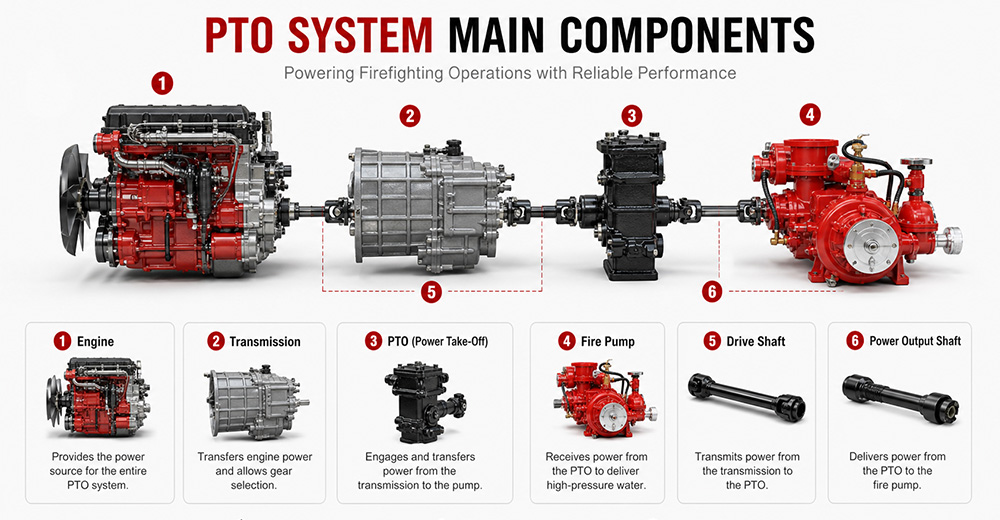
Pam bomba ialah beban akhir sistem PTO, yang bertanggungjawab menukar tenaga mekanikal kepada tenaga tekanan air.
Fungsi:Menerima kuasa putaran daripada PTO, memacu pendesak untuk berputar, menarik masuk air dan melepaskannya pada tekanan tinggi.
Jenis:Pam empar (satu peringkat, dua peringkat atau berbilang peringkat).
Kadar aliran biasa:20 L/s – 180 L/s (1,200 – 6,000 L/min).
Tekanan biasa:1.0 – 2.5 MPa (10 – 25 bar).
Sistem kawalan PTO ialah "pusat arahan" antara pemandu dan sistem PTO, yang bertanggungjawab terhadap penggandingan, penyahgandingan, perlindungan keselamatan dan petunjuk status.
Fungsi:Mengawal penggandingan dan penyahgandingan PTO, memantau status sistem dan menyediakan perlindungan keselamatan.
Lokasi operasi:Bahagian dalam kabin (kawalan utama) dan panel pam (kawalan tambahan).
Kaedah kawalan:Kabel manual, solenoid elektrik, pneumatik.
Fungsi kawalan khusus:
(1) Kawalan Penggandingan PTO
Pengendali menekan suis PTO (solenoid elektrik/pneumatik) atau menarik tuil (manual) di dalam kabin. Sistem kawalan menghantar isyarat untuk menggandingkan gear dalaman PTO dengan sumber kuasa. Selepas penggandingan berjaya disahkan, lampu penunjuk menyala, membolehkan pengendali meningkatkan RPM enjin.
(2) Kawalan Penyahgandingan PTO
Pengendali menekan suis sekali lagi atau menetapkan semula tuil. Sistem kawalan memutuskan isyarat dan gear PTO dinyahgandingkan. Selepas penyahgandingan disahkan, lampu penunjuk terpadam.
| Jenis PTO | Kedudukan Pemasangan | Sumber Kuasa | Output Kuasa | Aplikasi Biasa |
| PTO Sandwic | Antara enjin dan transmisi | Roda tenaga enjin | Kuasa penuh (≥90%) | Kenderaan pam bomba, lori berplatform udara |
| PTO aci belah | Aci pemacu bahagian tengah casis | Aci keluaran transmisi | Kuasa penuh | Lori vakum besar, lori bomba lapangan terbang |
| PTO dipasang di sisi | Bahagian sisi transmisi | Gear transmisi | Kuasa separa (lebih rendah) | Lori penyiram, lori vakum kecil |
PTO sandwic
Kelebihan:Keluaran kuasa penuh (≥90%), menyokong "pengepaman semasa memandu" (fungsi dwi), kecekapan penghantaran tinggi, pelinciran mudah.
Kekurangan:Kos lebih tinggi, pemasangan kompleks, memerlukan pengubahsuaian pada sambungan enjin-transmisi.
PTO aci belah
Kelebihan:Keluaran kuasa penuh, tidak memerlukan ruang tambahan, kebolehpercayaan tinggi, keseimbangan dinamik yang baik, boleh menggantikan enjin tambahan untuk memacu pam besar.
Kekurangan:Memerlukan pemotongan aci pemacu asal, pemilihan kedudukan pemasangan mesti mempertimbangkan sudut aci pemacu dan pampasan panjang.
PTO dipasang di sisi
Kelebihan:Kos rendah, pemasangan mudah, boleh mengambil kuasa terus dari bahagian sisi transmisi.
Kekurangan:Hanya kuasa separa tersedia, tork keluaran lebih rendah, tidak boleh memacu pam bomba berkuasa tinggi, terutamanya digunakan untuk peralatan berkelajuan rendah dan berkuasa rendah.
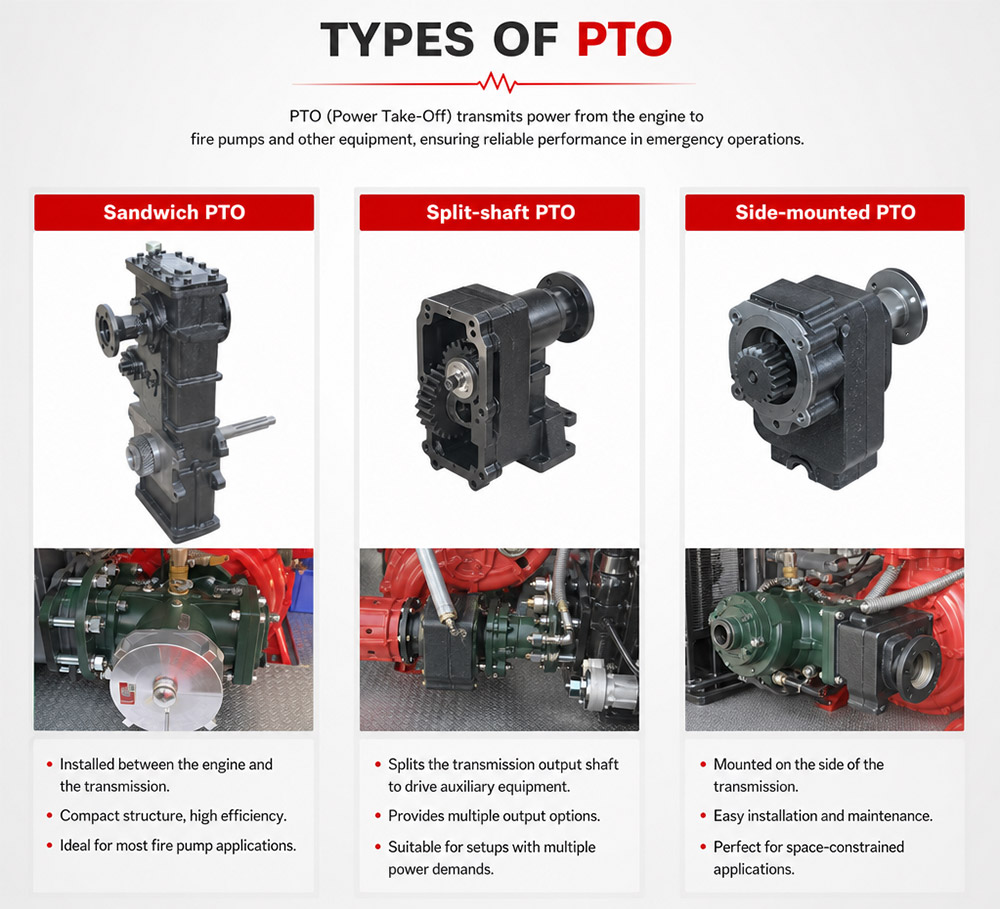
Proses ini mengikut rantaian penghantaran mekanikal yang jelas:
Enjin → PTO → Aci Pemacu → Pam Bomba → Putaran Pendesak → Sedutan → Peningkatan Tekanan → Monitor Bomba
| Faktor | Peranan |
|---|---|
| Ciri pam empar | Apabila kelajuan pendesak adalah malar, tekanan pelepasan kekal stabil secara semula jadi |
| Sambungan tegar PTO | Tiada gelinciran atau kehilangan kuasa, memastikan input kuasa berterusan dan stabil |
| Pengawal tekanan | Mengesan perubahan aliran secara automatik dan melaraskan RPM enjin untuk mengekalkan tekanan yang ditetapkan |
| Injap pelega | Memintas secara automatik apabila tekanan melebihi had, mencegah kerosakan peralatan |
① Kelajuan pam ditentukan oleh RPM enjin
Kelajuan pendesak pam bomba = RPM enjin × nisbah PTO. Nisbah PTO adalah tetap (contohnya, 1.75:1), jadi kelajuan pam berubah secara langsung mengikut RPM enjin.
Formula pengiraan:
RPM enjin × nisbah PTO = Kelajuan pam (RPM)
② Hubungan fizikal antara tekanan dan kelajuan
Tekanan yang dijana oleh pam empar adalah berkadar dengan kuasa dua kelajuan pendesak. Hukum fizik ini bermaksud perubahan kecil dalam RPM menyebabkan turun naik tekanan yang ketara.
Kelajuan meningkat → Daya empar meningkat → Tekanan pelepasan meningkat
Kelajuan menurun → Daya empar menurun → Tekanan pelepasan menurun
1. PTO tidak boleh diaktifkan
Punca yang mungkin: Tekanan udara rendah (jenis pneumatik), solenoid rosak, kabel rosak atau tersekat, keadaan interlock tidak dipenuhi (brek parkir tidak digunakan, transmisi tidak dalam keadaan neutral).
Penyelesaian: Periksa tekanan sistem udara (mesti ≥0.6 MPa); uji solenoid; periksa kabel; pastikan brek parkir digunakan dan transmisi berada dalam keadaan neutral.
2. PTO diaktifkan tetapi pam tidak berfungsi
Punca yang mungkin: Klac PTO rosak, aci pemacu patah atau spline haus, gear dalaman rosak.
Penyelesaian: Periksa penglibatan klac PTO; periksa aci pemacu untuk kerosakan atau sambungan longgar; buka dan periksa gear dalaman.
3. Bunyi luar biasa PTO
Punca yang mungkin: Jaringan gear yang lemah atau haus, galas haus, pelinciran tidak mencukupi atau merosot, PTO tidak dilepaskan sepenuhnya.
Penyelesaian: Periksa kelegaan gear dan kehausan gigi; periksa galas; gantikan dengan pelincir yang sesuai; pastikan PTO dilepaskan sepenuhnya.
4. Kebocoran minyak PTO
Punca yang mungkin: Pengedap haus atau merosot, perumah retak, bolt pemasangan longgar.
Penyelesaian: Gantikan pengedap (gelang O, pengedap minyak); periksa perumah untuk keretakan; ketatkan bolt pemasangan.
5. PTO terlalu panas
Punca yang mungkin: Operasi beban tinggi yang berpanjangan, minyak pelincir tidak mencukupi atau merosot, kegagalan sistem penyejukan.
Penyelesaian:Kurangkan beban atau matikan operasi untuk penyejukan; gantikan dengan pelincir yang layak; periksa saluran penyejukan.
6. Kuasa PTO tidak mencukupi
Punca yang mungkin:Pemilihan nisbah PTO yang tidak betul, RPM enjin ditetapkan terlalu rendah, gelinciran klac.
Penyelesaian:Sahkan nisbah PTO sepadan dengan pam kebakaran; tingkatkan RPM enjin ke julat operasi berkadar; periksa klac untuk gelinciran.
S1. Apakah maksud PTO pada trak bomba?
PTO bermaksud Power Take-Off. Ia ialah sistem mekanikal yang memindahkan kuasa enjin daripada transmisi trak ke pam kebakaran. Secara ringkasnya, PTO membolehkan enjin trak bomba menggerakkan sistem pengepaman supaya ia boleh membekalkan air bertekanan tinggi atau buih untuk operasi pemadaman kebakaran tanpa memerlukan enjin berasingan. Ia merupakan komponen penting dalam trak bomba industri dan perbandaran.
S2. Mengapa trak bomba memerlukan PTO?
Trak bomba memerlukan PTO kerana ia membolehkan enjin utama kenderaan memacu pam kebakaran dengan cekap. Tanpa PTO, pam kebakaran memerlukan enjin berasingan, yang meningkatkan kos, berat, dan kerumitan penyelenggaraan. Sistem PTO menyediakan cara yang padat, boleh dipercayai, dan menjimatkan bahan api untuk memastikan bekalan air atau buih berterusan semasa operasi pemadaman kebakaran.
S3. Bolehkah trak bomba beroperasi tanpa PTO?
Kebanyakan trak bomba moden tidak boleh mengendalikan sistem pengepamannya tanpa PTO kerana PTO bertanggungjawab memindahkan kuasa enjin ke pam kebakaran. Walau bagaimanapun, sesetengah kenderaan bomba khusus mungkin menggunakan enjin tambahan bebas untuk menggerakkan pam. Reka bentuk ini kurang biasa kerana kos lebih tinggi, penyelenggaraan meningkat, dan kecekapan lebih rendah berbanding sistem berasaskan PTO.
S4. Apakah perbezaan antara PTO dan pam kebakaran?
PTO ialah peranti penghantaran kuasa, manakala pam kebakaran ialah sistem pengepaman air atau buih. PTO menyalurkan kuasa mekanikal daripada enjin ke pam, dan pam kebakaran menukarkan kuasa tersebut kepada tekanan hidraulik untuk menggerakkan air atau buih. Ringkasnya, PTO ialah "penyambung sumber kuasa", dan pam kebakaran ialah "peranti output pemadaman kebakaran".
S5. Berapakah kuasa yang boleh dibekalkan oleh PTO trak bomba?
Output kuasa PTO trak bomba bergantung pada reka bentuk kenderaan dan sistem transmisi. Lazimnya, sistem PTO boleh membekalkan antara 50 kW hingga lebih 300 kW kuasa mekanikal. Trak bomba industri berat dan lapangan terbang sering menggunakan sistem PTO berkapasiti tinggi yang mampu menyokong pam kebakaran aliran besar dan operasi tekanan tinggi berterusan.
S6. Apakah jenis-jenis PTO trak bomba yang berbeza?
Terdapat beberapa jenis sistem PTO trak bomba, termasuk PTO dipasang sisi, PTO dipasang belakang, PTO aci belah, dan PTO kuasa penuh. PTO dipasang sisi biasanya digunakan pada trak bomba standard, manakala sistem PTO aci belah dan PTO kuasa penuh digunakan pada trak bomba industri dan lapangan terbang yang memerlukan output kuasa lebih tinggi serta operasi berterusan.
S7. Bagaimanakah cara menyelenggara PTO trak bomba?
Penyelenggaraan PTO merangkumi pemeriksaan berkala paras minyak pelinciran, pemeriksaan kebocoran, mengetatkan bolt pemasangan, dan memastikan penjajaran aci pemacu yang betul. Operator juga perlu menguji fungsi pengaktifan dan nyahpengaktifan secara berkala. Penyelenggaraan pencegahan amat penting untuk mengelakkan pemanasan melampau, kehausan mekanikal, dan kegagalan tidak dijangka semasa operasi kecemasan.
S8. Apakah punca PTO trak bomba gagal?
Punca biasa kegagalan PTO termasuk pelinciran tidak mencukupi, gear haus, ketidakjajaran aci pemacu, pemanasan melampau, dan pengendalian yang tidak betul oleh pemandu. Kegagalan sistem kawalan elektrik atau hidraulik juga boleh menghalang pengaktifan PTO. Penyelenggaraan berkala dan prosedur operasi yang betul dapat mengurangkan risiko kegagalan PTO dengan ketara.
S9. PTO manakah yang terbaik untuk trak bomba industri?
Untuk trak bomba industri, pilihan terbaik biasanya ialah sistem PTO aci belah atau PTO kuasa penuh. Sistem ini mampu mengendalikan output kuasa tinggi, operasi berterusan, dan pam kebakaran berkapasiti besar. Ia digunakan secara meluas di loji petrokimia, kilang penapisan, lapangan terbang, dan kemudahan industri besar yang memerlukan prestasi pemadaman kebakaran yang boleh dipercayai serta berjangka panjang.
S10. Apakah yang perlu dipertimbangkan oleh pembeli ketika memilih PTO trak bomba?
Pembeli perlu mempertimbangkan keserasian kuasa enjin, kadar aliran pam kebakaran yang diperlukan, jenis kenderaan, dan persekitaran kerja. Penting juga untuk menilai ketahanan PTO, prestasi penyejukan, kemudahan penyelenggaraan, dan keserasian dengan casis. Bagi projek eksport, pematuhan terhadap piawaian antarabangsa dan peraturan tempatan juga perlu diambil kira bagi memastikan kelulusan dan kebolehpercayaan operasi.
PTO (Power Take-Off) ialah sistem teras yang memindahkan kuasa enjin kepada pam kebakaran — ia menentukan sama ada keseluruhan sistem pemadaman kebakaran dapat beroperasi dengan betul.
Rantaian kuasa trak bomba ialah: Enjin → Transmisi → PTO → Aci Pemacu → Pam Kebakaran → Monitor Kebakaran. Sebarang pautan lemah dalam rantaian ini akan menjejaskan prestasi pemadaman kebakaran akhir.
Fungsi utama PTO adalah untuk menyediakan output kuasa mekanikal yang stabil dan berterusan, membolehkan trak bomba membekalkan air atau buih dengan cekap tanpa memerlukan enjin berasingan.
Jenis PTO yang berbeza (Dipasang sisi, Dipasang belakang, Aci belah, Kuasa penuh) sesuai untuk kelas trak bomba yang berbeza. Trak bomba industri biasanya mengutamakan sistem PTO berkuasa tinggi.
Prestasi PTO mesti sepadan dengan kadar aliran pam kebakaran dan casis kenderaan, jika tidak masalah seperti kuasa tidak mencukupi, tekanan tidak stabil, atau beban lampau sistem mungkin berlaku.
Penyelenggaraan berkala sistem PTO (pelinciran, pengetatan, pemeriksaan penjajaran) adalah kunci untuk memastikan operasi trak bomba yang boleh dipercayai, terutamanya dalam aplikasi industri berintensiti tinggi.
Apabila membeli trak bomba industri, pembeli tidak seharusnya hanya memberi tumpuan kepada harga. Kuasa PTO, kestabilan, keserasian, dan sokongan selepas jualan merupakan faktor penting yang sama untuk dinilai.
Untuk situasi berisiko tinggi seperti loji petrokimia, lapangan terbang, dan taman perindustrian besar, sistem PTO Kuasa Penuh atau PTO Aci Belah disyorkan bagi memastikan keupayaan operasi berterusan.


Anda mungkin berminat dengan maklumat berikut
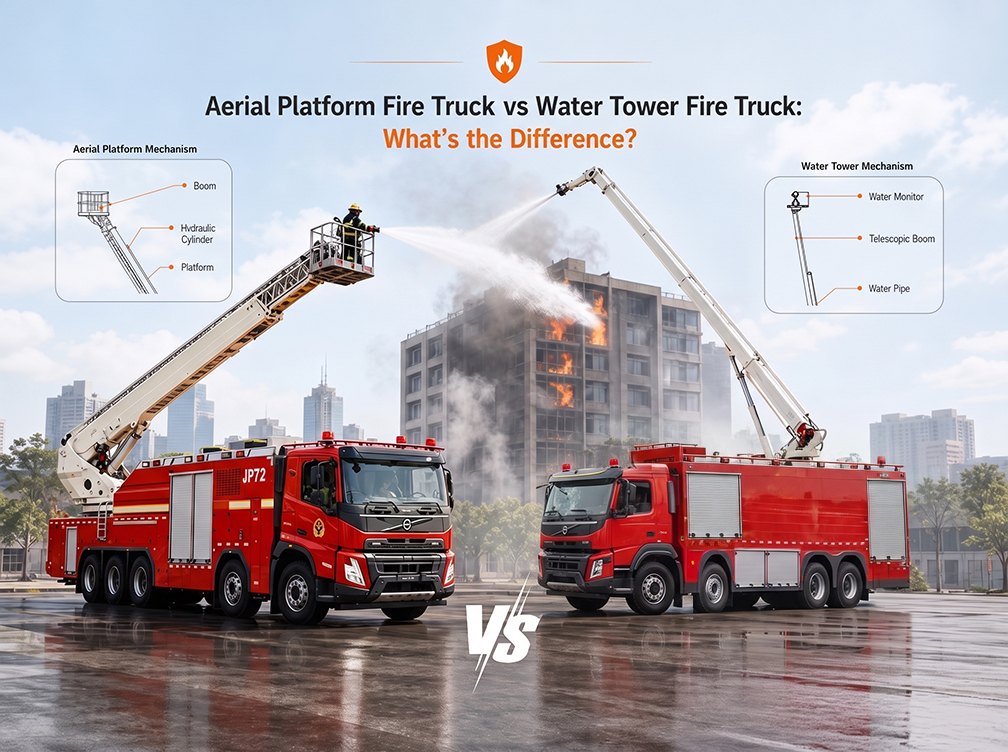
Apabila melibatkan pemadaman kebakaran di bangunan bertingkat tinggi, kemudahan industri, atau gudang besar, trak bomba udara adalah tidak dapat digantikan. Namun, antara pelbagai jenis peralatan udara, dua jenis sering menimbulkan kekeliruan: trak bomba platform udara dan trak bomba menara air. Walaupun kelihatan serupa pada pandangan pertama—kedua-duanya mempunyai boom hidraulik dan direka untuk pemadaman kebakaran di tempat tinggi—kedua-duanya mempunyai misi yang berbeza secara asas. Artikel ini menghuraikan perbezaan utama antara kedua-dua jenis kenderaan ini, membantu profesional perkhidmatan bomba, pengurus perolehan, dan pengedar peralatan membuat keputusan berdasarkan keperluan operasi. I. Apakah Itu Trak Platform Udara? Menurut piawaian kebangsaan China GB 7956.12-2015, kedua-dua kenderaan ini tergolong dalam kategori kenderaan pemadam kebakaran udara—kenderaan yang dilengkapi dengan boom pengangkat, meja putar, dan peralatan pemadam kebakaran untuk operasi altitud tinggi. Walau bagaimanapun, definisi khususnya menunjukkan perbezaan kritikal. Trak Bomba Platform Udara Trak bomba platform udara dilengkapi dengan boom gabungan boleh lipat atau boleh lipat-teleskopik, platform kakitangan, meja putar, dan peranti pemadam kebakaran. Ciri utama ialah platform kerja (bakul) di hujung boom, tempat anggota bomba boleh berdiri untuk menjalankan operasi menyelamat dan pemadaman kebakaran. Ciri-ciri utama:• Dilengkapi dengan platform yang boleh membawa 750 paun hingga lebih daripada 1,500 paun anggota dan peralatan• Direka untuk kedua-dua penyelamatan dan pemadaman kebakaran—anggota bomba boleh beroperasi terus dari platform• Platform boleh digunakan bersama peranti kawalan penurunan, win hidraulik, atau gelongsor penyelamat• Jangkauan mendatar yang lebih luas dan jarak kerja yang lebih besar berbanding menara air II. Apakah Itu Trak Bomba Menara Air? Trak bomba menara air dilengkapi dengan boom gabungan boleh lipat atau boleh lipat-teleskopik, meja putar, dan peranti pemadam kebakaran—tanpa platform kakitangan. Sebaliknya, monitor air (meriam air) dipasang pada hujung boom, yang boleh dikawal dari jauh dari tanah. Ciri-ciri utama:• Tiada platform kakitangan—anggota bomba beroperasi dari tanah melalui kawalan jauh• Difokuskan sepenuhnya pada pemadaman kebakaran di tempat tinggi, bukan penyelamatan• Menyampaikan aliran air yang sangat tinggi—melebihi 2,000 gelen seminitpada banyak model industri• Direka untuk perlindungan kebakaran industri yang tidak memerlukan keupayaan menyelamat III. Perbandingan Sebelah Menyebelah Ciri Trak Bomba Platform Udara Trak Bomba Menara Air Fungsi Utama Menyelamat + pemadaman kebakaran Pemadaman kebakaran sahaja Peralatan Hujung Boom Platform kerja (bakul) untuk anggota Monitor kebakaran (meriam air) Anggota pada Boom Ya—anggota bomba boleh beroperasi dari platform Tidak—dikendalikan dari tanah melalui kawalan jauh Keupayaan Menyelamat Tinggi—boleh memindahkan individu yang terperangkap Tiada Kapasiti Aliran Air...
Perincian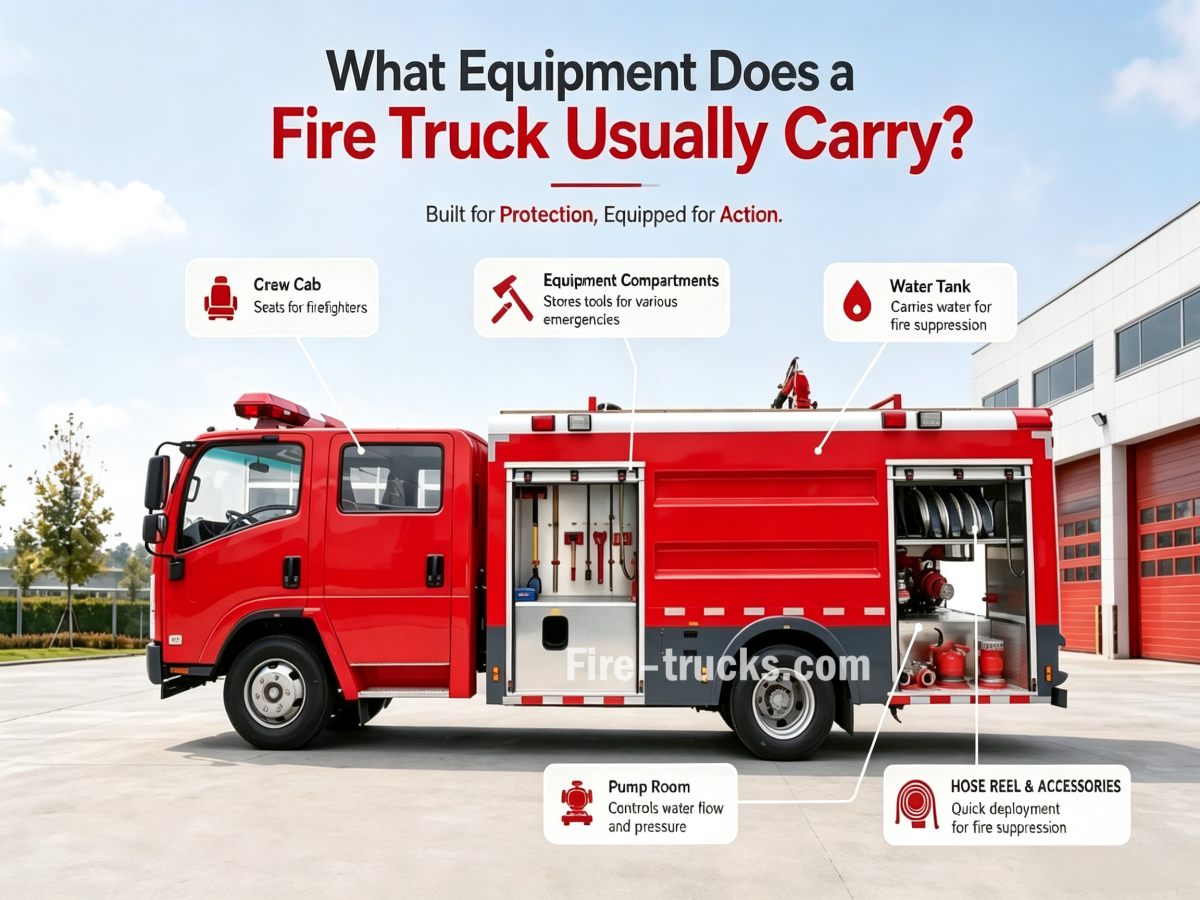
Sebuah trak bomba biasanya membawa peralatan pemadaman kebakaran, bekalan air, penyelamatan dan perlindungan keselamatan. Peralatan biasa termasuk pam bomba, tangki air, hos bomba, muncung bomba, monitor bomba, injap, tangga bomba, alat penyelamat, peralatan perlindungan dan peranti komunikasi. Artikel ini menghuraikan secara sistematik pengelasan, fungsi dan pertimbangan pemilihan bagi peralatan standard trak bomba peralatan, membantu profesional perolehan dan pengguna akhir membina pemahaman lengkap tentang konfigurasi jentera bomba. I. Pengelasan Peralatan Trak Bomba 1. Peralatan Pemadaman Kebakaran— Alat teras untuk pemadaman kebakaran secara langsung, termasuk muncung bomba, monitor bomba, hos bomba, pembahagi air dan penyesuai. 2. Peralatan Penyelamatan dan Pecah Masuk— Alat untuk mencipta laluan akses bagi operasi penyelamatan dan pemadaman kebakaran, termasuk alat penyelamat hidraulik, kapak bomba, batang cungkil, linggis, gergaji pemotong dan gergaji rantai. 3. Peralatan Penyelamatan dan Menyelamatkan Nyawa— Peralatan untuk pencarian, pemindahan dan perlindungan anggota, termasuk pengusung, tali penyelamat, cangkuk keselamatan, peranti kawalan penurunan, alat pernafasan kendiri (SCBA) dan silinder udara ganti. 4. Peralatan Pembuangan Asap dan Pencahayaan— Peralatan untuk memperbaiki keadaan di lokasi kebakaran, termasuk pengusir asap, menara pencahayaan mudah alih dan lampu sorot carian berintensiti tinggi mudah alih. 5. Peralatan Perlindungan Peribadi (PPE)— Kelengkapan untuk melindungi keselamatan anggota bomba, termasuk topi keledar, pakaian perlindungan pemadaman kebakaran struktur, sarung tangan, but dan tali pinggang keselamatan. 6. Peralatan Komunikasi dan Peninjauan— Peralatan untuk pengumpulan maklumat di lokasi kebakaran dan penyelarasan arahan, termasuk radio dua hala, kamera pengimejan haba dan pengesan gas toksik. II. Peralatan Pemadaman Kebakaran pada Trak Bomba 1. Pam Bomba Pam bomba ialah sumber kuasa bagi semua operasi pemadaman kebakaran. Ia memberi tekanan secara mekanikal kepada air, memberikan tenaga kinetik yang mencukupi untuk melengkapkan keseluruhan proses "menyedut air → memberi tekanan → menghantar → menyahcas." Spesifikasi biasa pam bomba: • Pam Bomba Tekanan Standard (jenis CB10/30):Kadar aliran ≥30L/s, tekanan berkadar 1.0MPa, pemasangan di bahagian belakang. Sesuai untuk tangki air bomba standard dan trak bomba buih, memenuhi kebanyakan keperluan bekalan air pemadaman kebakaran bandar dan industri. • Pam Bomba Tekanan Sederhana/Tinggi:Aliran tekanan rendah 30L/s pada 1.0MPa, aliran tekanan tinggi 20L/s pada 2.0MPa, pemasangan di bahagian belakang. Reka bentuk tekanan dwi menyokong bekalan isipadu tinggi (tekanan rendah) serta penghantaran jarak jauh/tinggi (tekanan tinggi) menggunakan satu pam. Sesuai untuk trak bomba tempur utama bandar dan senario pemadaman kebakaran bangunan tinggi. • Pam Bomba Tekanan Tinggi:Kadar aliran 10-15L/s, tekanan sehingga 4.0MPa atau lebih tinggi, pemasangan di bahagian belakan...
Perincian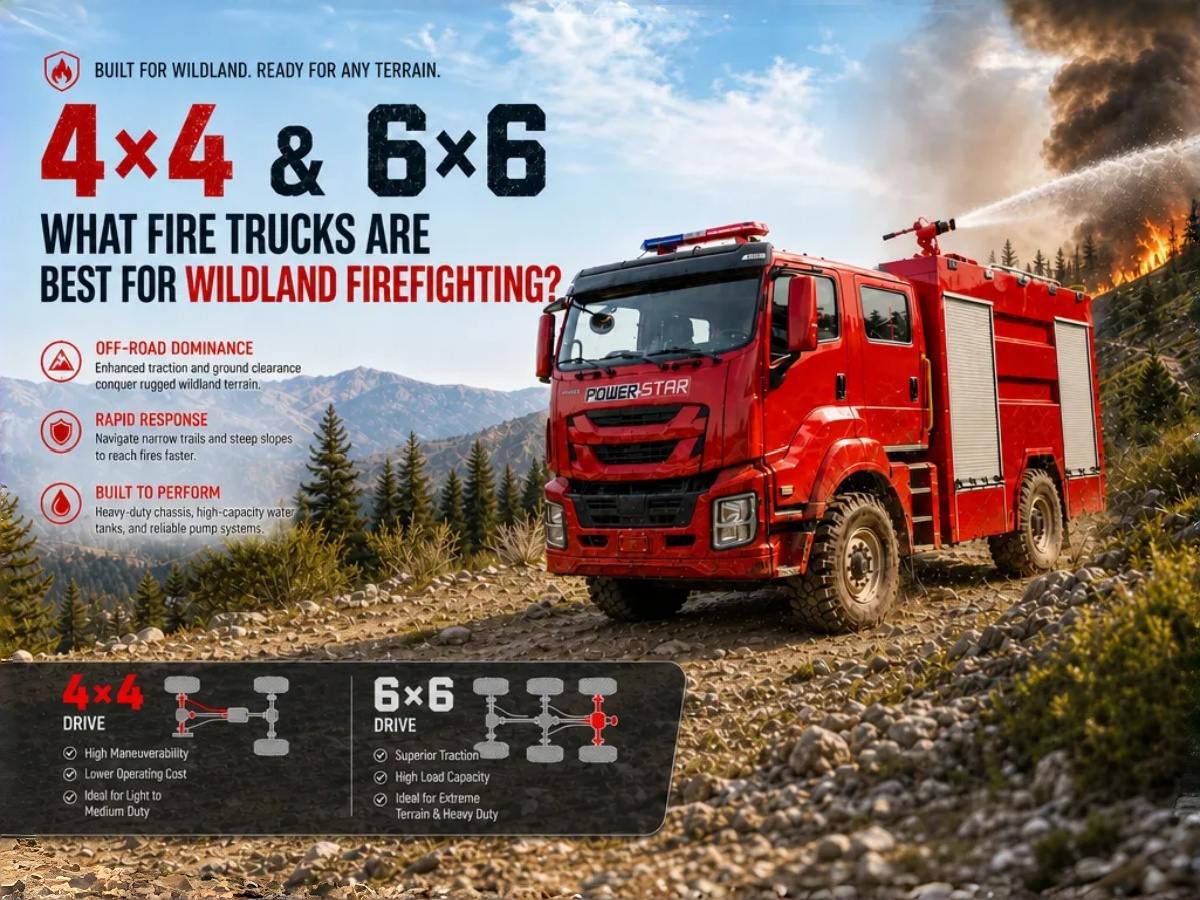
Pemadaman kebakaran hutan dan kawasan liar menghadirkan cabaran yang pada asasnya berbeza daripada pemadaman kebakaran struktur. Di hutan terpencil, padang rumput, dan kawasan pergunungan, trak bomba mesti melalui laluan sempit, mendaki cerun curam, dan beroperasi jauh dari pili bomba atau sumber air. Memilih trak pemadam kebakaran yang tepat ialah keputusan strategik yang secara langsung mempengaruhi masa tindak balas, keselamatan kru, dan keberkesanan pemadaman kebakaran. Artikel ini memberikan huraian menyeluruh tentang jenis trak bomba yang paling sesuai untuk pemadaman kebakaran hutan dan kawasan liar, ciri terasnya, serta kaedah pemilihan, membantu anda membuat keputusan yang tepat berdasarkan keperluan operasi khusus anda. Jawapan Ringkas Kebakaran hutan dan kawasan liar dicirikan oleh kawasan kebakaran yang luas, bentuk muka bumi yang kompleks, sumber air yang terhad, dan keadaan jalan yang buruk, jadi tiada satu trak bomba yang boleh menangani semua situasi kebakaran hutan. Secara umum, pemadaman kebakaran hutan dan kawasan liar terutamanya menggunakan jenis trak bomba berikut: • Trak bomba hutan dan kawasan liar ringan: untuk akses jalan hutan dan tindak balas pantas• Trak bomba hutan dan kawasan liar pacuan luar jalan 4×4: untuk kawasan pergunungan dan berbukit• Trak bomba hutan dan kawasan liar 6×6: untuk kebakaran hutan berskala besar dan operasi berpanjangan• Tangki air: untuk bekalan air berterusan dan sokongan• Trak bomba buih: untuk kemudahan minyak, peralatan hutan, atau kebakaran khas• Kenderaan penyelamat: untuk komunikasi, pencahayaan, pemecahan halangan, dan sokongan logistik I. Mengapa Kebakaran Hutan dan Kawasan Liar Memerlukan Trak Bomba Khusus? Kebakaran hutan dan kawasan liar berbeza secara asas daripada kebakaran struktur dalam beberapa aspek kritikal: Ciri utama kebakaran hutan dan kawasan liar:• Kawasan kebakaran yang luas meliputi hektar tanah• Arah angin yang berubah dengan cepat• Bentuk muka bumi yang kompleks dan lasak• Akses terhad atau tiada akses kepada pili bomba atau sumber air• Jalan hutan sempit dan tidak berturap• Keadaan komunikasi yang sukar Trak bomba bandar standard biasanya tidak sesuai untuk pemadaman kebakaran hutan dan kawasan liar atas sebab berikut: •Tidak mempunyai pacuan 4×4 atau pacuan semua roda untuk jalan gunung tidak berturap dan cerun curam;•Saiz yang lebih besar dan kelegaan tanah yang rendah menyebabkan ia mudah tersangkut di laluan hutan sempit dan kawasan lembut;•Pam bandar mengutamakan kadar aliran tinggi pada tekanan sederhana, manakala operasi hutan dan kawasan liar memerlukan tekanan tinggi melalui sambungan hos yang panjang dengan air terhad—pendekatan yang pada asasnya berbeza. II. Jenis Biasa Trak Bomba Hutan dan Kawasan Liar Jenis Trak Bomba Ciri Utama Senario Penggunaan Trak Bomba Hutan dan Kawasan Liar Ringan Mobiliti tinggi, saiz kompak Rondaan hutan, serangan awal Trak Bomba Hutan dan Kawasan Liar 4x4 Keupayaan luar jalan yang kuat Kawasan pergunungan dan berbukit Trak ...
Perincian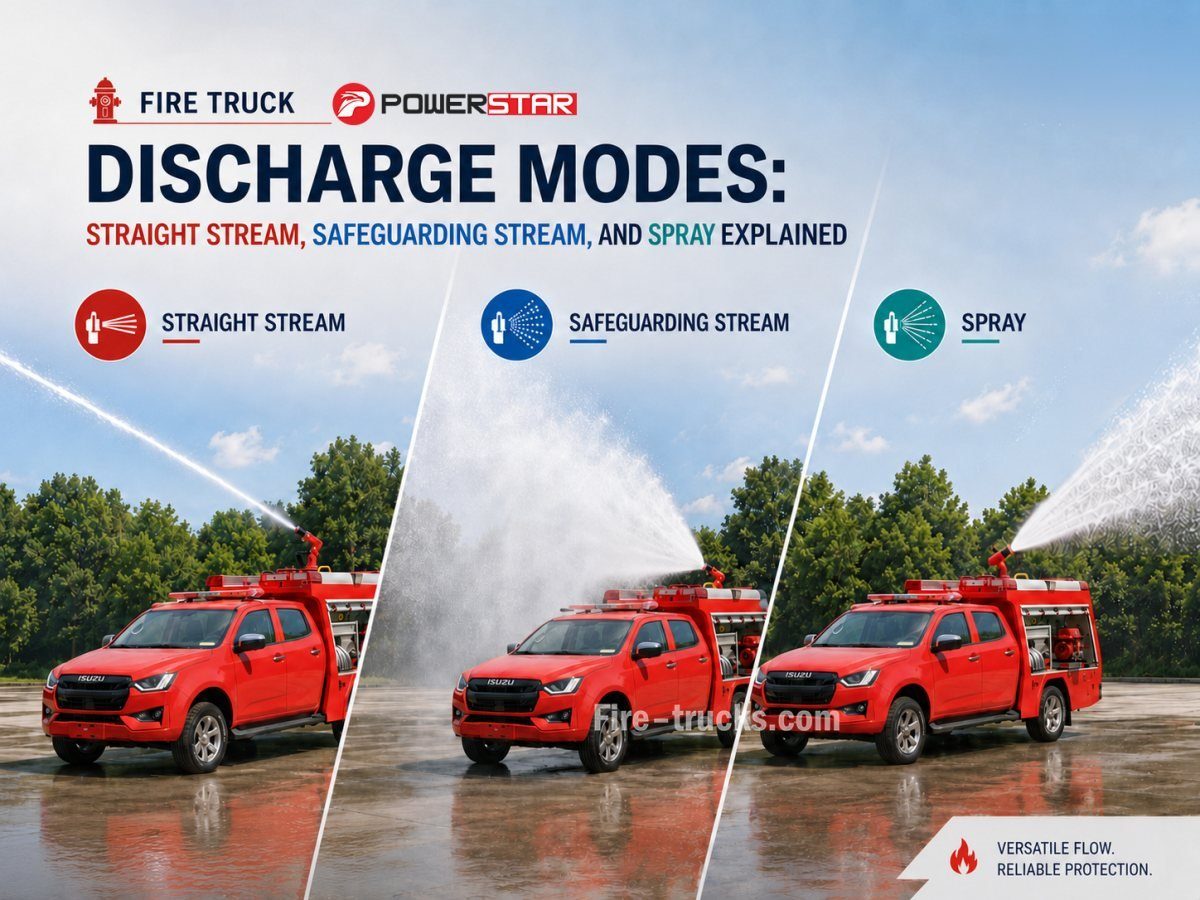
Dalam operasi pemadaman kebakaran, pemilihan mod pelepasan secara langsung menentukan kecekapan pemadaman api, keselamatan operasi dan keberkesanan kawalan kebakaran. Kebanyakan orang tidak menyedari bahawa trak bomba muncung boleh bertukar antara tiga mod pelepasan teras: aliran lurus, aliran semburan dan aliran perlindungan. Mod yang berbeza mempunyai perbezaan ketara dari segi corak aliran, jarak, daya hentaman dan kawasan liputan, dan setiap satu berkaitan dengan situasi kebakaran yang sama sekali berbeza. Artikel ini, berdasarkan piawaian operasi pemadaman kebakaran profesional, menganalisis secara menyeluruh prinsip, ciri utama dan senario penggunaan bagi tiga mod pelepasan tersebut, membantu pelanggan kami menguasai teknik pelepasan trak bomba secara sistematik. I. Mengapa Trak Bomba Memerlukan Mod Pelepasan Berbeza? Aliran lurus, aliran semburan dan aliran perlindungan sepadan dengan tiga mekanisme pemadaman api yang berbeza: pemadaman melalui hentaman, penyesakan melalui pengewapan dan perlindungan sinaran haba. Anggota bomba mesti menukar mod secara fleksibel mengikut keadaan lokasi. Jadi, mengapa kita tidak boleh terus menggunakan hanya satu jenis aliran? 1. Kepelbagaian jenis kebakaran memerlukan bentuk medium pemadam yang berbeza Jenis kebakaran yang berbeza mempunyai ciri pembakaran yang berbeza, yang menentukan kaedah pemadaman yang sesuai: • Kebakaran bahan pepejal Kelas A memerlukan hentaman aliran lurus untuk memecahkan bahan yang terbakar dan menembusi bagi penyejukan dalaman; • Kebakaran cecair Kelas B tidak boleh menggunakan hentaman aliran lurus (yang menyebabkan percikan dan menyebarkan api), tetapi perlu menggunakan aliran perlindungan atau aliran semburan untuk penutupan dan pencairan; • Kebakaran elektrik berarus Kelas E hanya boleh menggunakan aliran semburan, kerana titisan air halus tidak membentuk laluan pengalir berterusan; • Kebakaran dalam ruang tertutup memerlukan aliran semburan untuk memenuhi seluruh ruang, mencapai pemadaman melalui penyerapan haba pengewapan dan penyesakan. Tiada satu mod tunggal yang boleh menyesuaikan diri dengan semua jenis kebakaran. 2. Tahap berbeza bagi kebakaran yang sama memerlukan pendekatan taktikal yang berbeza Walaupun untuk kebakaran yang sama, tahap yang berbeza memerlukan mod pelepasan yang berbeza: • Pada peringkat awal apabila api sangat marak, aliran lurus diperlukan untuk menghentam titik api dari jarak jauh bagi penindasan pantas; • Semasa mara ke hadapan, aliran perlindungan diperlukan untuk membentuk penghalang tirai air bagi menyekat sinaran haba dan melindungi anggota; • Sebelum memasuki bilik, aliran semburan diperlukan untuk menyejukkan dan mencairkan asap serta gas, mewujudkan keadaan untuk serangan dalaman. Satu mod tunggal tidak dapat memenuhi keperluan operasi sepanjang keseluruhan proses pemadaman kebakaran. 3. Jarak, kawasan liputan dan kecekapan penyejukan tidak dapat dicapai serentak Ketiga-tiga mod mempunyai kelebihan dan kekurangan tersendiri dalam tiga dim...
Perincian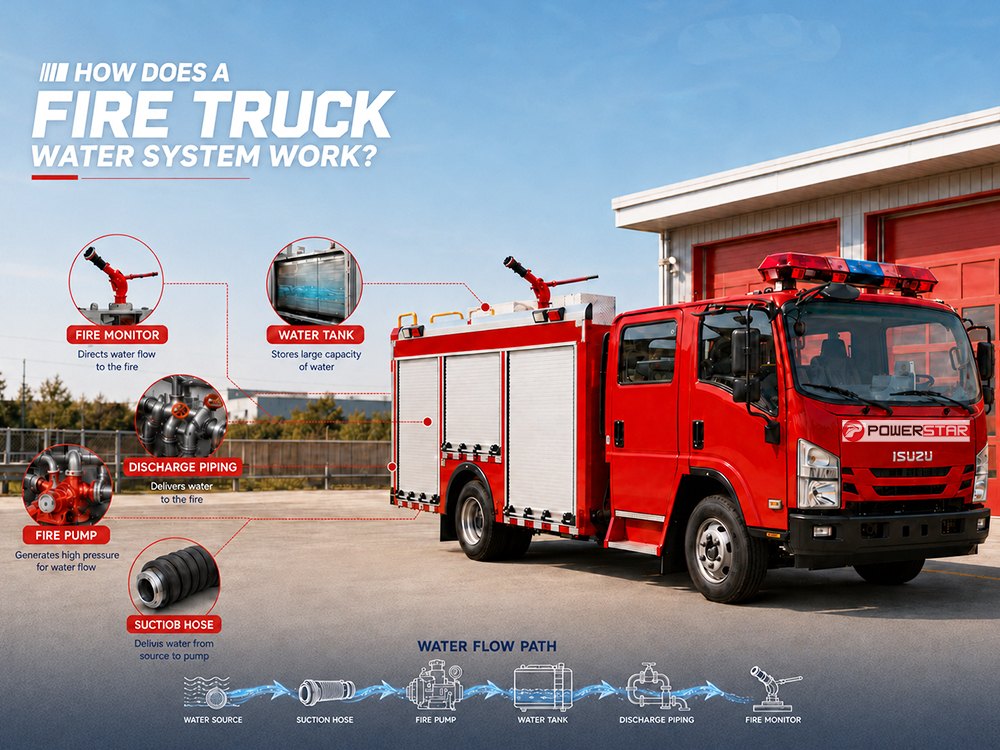
Sistem paip air trak bomba ialah teras bagi setiap operasi pemadaman kebakaran. Ia mengarahkan air dengan tepat dari tangki atau sumber luaran melalui pam, injap dan paip untuk menghantar air bertekanan tinggi atau buih ke lokasi kebakaran — sama ada kebakaran bangunan tinggi di pusat bandar yang padat atau kebakaran tangki penyimpanan petrokimia di kawasan perindustrian. trak bomba sistem paip air terdiri daripada pelbagai komponen yang berfungsi bersama: pam bomba, tangki air, hos sedutan, paip pelepasan, injap, penyambung pembahagi, penyambung pengumpul, penapis, monitor bomba, gandingan hos dan banyak lagi. Laluan aliran lengkap ialah: Tangki Air → Hos Sedutan → Penapis → Pam Bomba → Sistem Pengawalan Tekanan → Manifold Pelepasan → Injap → Penyambung Pembahagi → Monitor Bomba / Gandingan Hos → Muncung Artikel ini menerangkan setiap komponen sistem paip air dan cara komponen tersebut berfungsi bersama untuk menghantar air pada tekanan dan kadar aliran yang betul. I. Komponen Teras Sistem Paip Air Tangki Air Menyimpan bekalan air di atas kenderaan. ● Kapasiti: Biasanya 2,000–12,000 liter. ● Penghantaran: Membekalkan air kepada pam melalui paip masukan. ● Ciri-ciri: Sekat anti-olengan untuk kestabilan kenderaan, penapis untuk menapis serpihan, dan sistem penyebuan untuk mengambil air daripada sumber air semula jadi. Pam Bomba Pam empar yang digerakkan oleh enjin trak melalui PTO; satu peringkat/berbilang peringkat, besi tuang atau gangsa. ● Gred tekanan: Tersedia dalam penarafan standard 0.8 MPa, 1.0 MPa, 1.2 MPa dan 1.4 MPa, sepadan dengan keperluan pemadaman kebakaran biasa. ● Kadar aliran: Berjulat daripada 1,200 hingga 6,000 L/min, dengan lengkung prestasi dioptimumkan untuk operasi tekanan tinggi dan isipadu tinggi. Injap dan Paip Rangkaian paip dan injap yang mengawal arah serta isipadu aliran air. ● Injap masukan: Menyambungkan pam kepada sumber air luaran (hidran atau titik pengambilan air) ● Injap tangki-ke-pam: Membolehkan pam menarik air secara terus daripada tangki atas kenderaan ● Injap pelepasan: Mengawal aliran air ke hos dan muncung II. Cara Sistem Paip Air Trak Bomba Berfungsi Langkah 1: Pengambilan Air dan Penyebuan Air memasuki sistem daripada tangki atas kenderaan, hidran bomba atau sumber air semula jadi (tasik, sungai, kolam). Apabila mengambil air daripada sumber semula jadi, sistem penyebuan (pam vakum) mengeluarkan udara daripada hos sedutan, menghasilkan vakum yang membolehkan tekanan atmosfera menolak air masuk ke dalam pam. Penapis menapis serpihan untuk melindungi pam, dan injap sehala menghalang aliran balik. Langkah 2: Penekanan Pam Pam empar digerakkan oleh enjin trak melalui pacuan kuasa (PTO). Setelah air memenuhi pam, pendesak berputar pada kelajuan tinggi (1,500–2,500 RPM). Daya emparan menolak air ke arah luar, meningkatkan halajunya. Perumah pam menukar halaju ini kepada tekanan (biasanya 0.8–1.2 MPa). Pengawal tekanan elektronik mengekalkan tekanan yang ditetapkan secara automatik, manakala injap pelepas m...
Perincian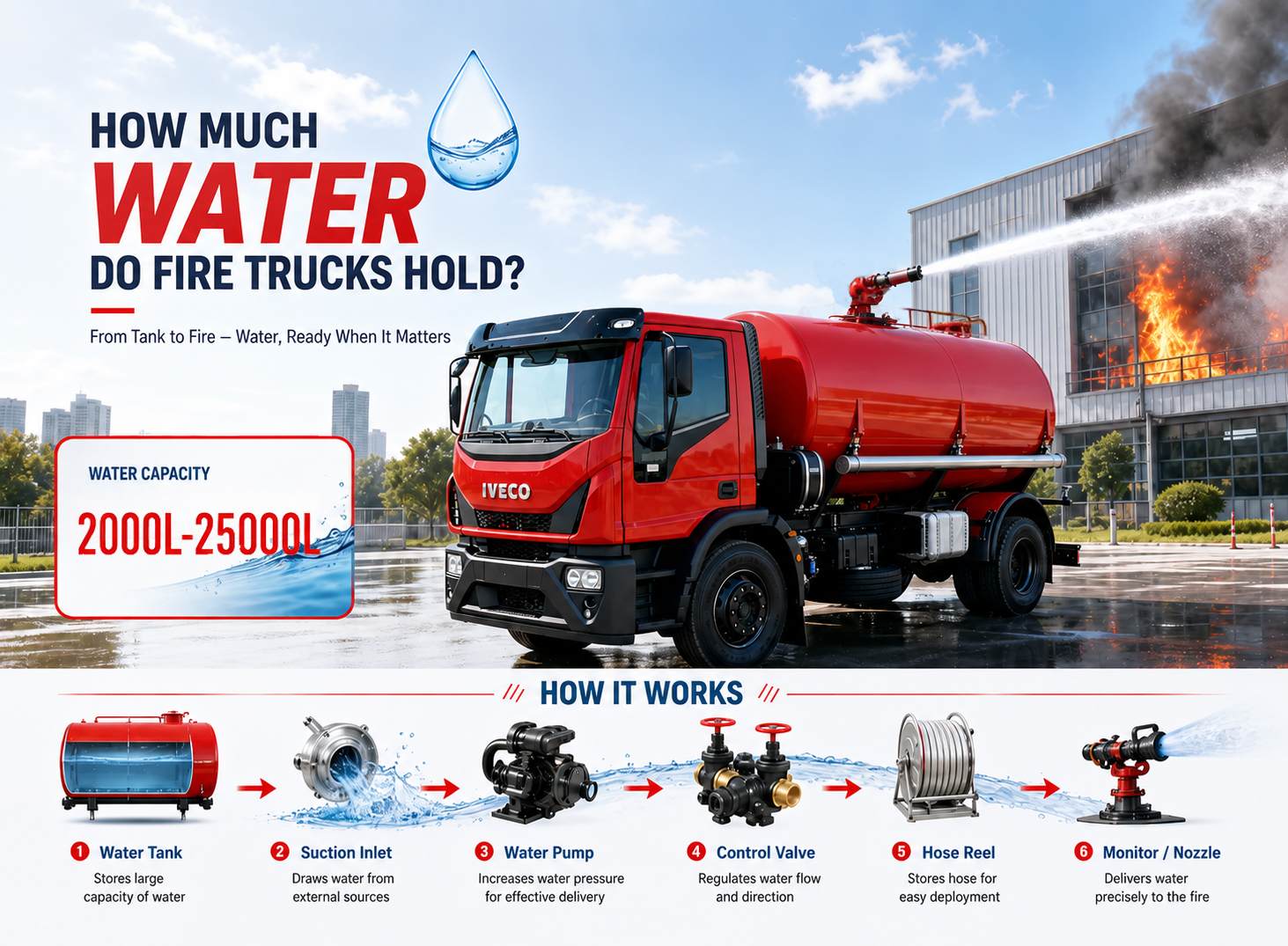
Berapa banyak air yang boleh dibawa oleh sebuah trak bomba? Ini ialah salah satu soalan pertama yang dihadapi oleh pelanggan kami apabila memilih trak bomba. Tiada satu angka tetap — ia bergantung pada jenis kenderaan, kapasiti casis, tujuan reka bentuk, dan peraturan serantau, bermula daripada unit tugas ringan berkapasiti 2,000 liter hingga trak bomba industri berkapasiti 25,000 liter. Namun, tangki yang lebih besar tidak semestinya bermaksud prestasi yang lebih baik;kenderaan pemadam kebakaran kapasiti tangki air mestilah dipadankan dengan betul dengan kadar aliran pam, kadar pelepasan monitor, dan kapasiti casis untuk memberikan hasil pemadaman kebakaran yang berkesan. Artikel ini bermula dengan asas kapasiti tangki air trak bomba, menganalisis julat simpanan biasa untuk jenis kenderaan yang berbeza, mengkaji faktor utama yang mempengaruhi reka bentuk tangki, dan memberikan panduan pembelian yang praktikal. Perkara Utama: Kapasiti tangki air trak bomba biasanya berada dalam julat 2,000 hingga 25,000 liter Jenis trak bomba yang berbeza mempunyai kapasiti tangki yang berbeza Tangki yang lebih besar tidak bermaksud keupayaan pemadaman kebakaran yang lebih baik Kapasiti tangki mesti dipadankan dengan aliran pam, aliran monitor, dan kapasiti casis Pemadaman kebakaran industri biasanya memerlukan tangki besar, manakala pemadaman kebakaran perbandaran mengutamakan kebolehgerakan » I. Tiga Jenis Asas Tangki Air Trak Bomba Trak Pam:Ini ialah trak bomba perbandaran yang paling biasa. Ia bergantung terutamanya pada pili bomba untuk bekalan air dan membawa kira-kira 1,900–3,800 liter air di atas kenderaan untuk serangan awal. Teras kenderaan ini ialah pam, bukan tangki — ia direka untuk menghantar air bertekanan selepas disambungkan kepada pili bomba. Trak Tangki (Pembawa Air):Kenderaan ini dikhususkan untuk mengangkut jumlah air yang besar, dengan kapasiti tangki biasanya melebihi 11,400 liter. Ia memainkan peranan penting di kawasan luar bandar dan terpencil yang tidak mempunyai pili bomba, dengan mengangkut air dari sumber air ke lokasi kebakaran untuk digunakan oleh trak pam. Trak Pam-Tangki:Kenderaan ini menggabungkan fungsi pengepaman dan pengangkutan air dalam satu unit. Ia boleh melepaskan air untuk pemadaman kebakaran serta membekalkan kenderaan lain. Kapasiti tangki biasanya berada antara 5,700 hingga 11,400 liter, menjadikannya penyelesaian serba guna untuk jabatan bomba. » II. Berapa Banyak Air Yang Boleh Dibawa Oleh Jenis Trak Bomba Yang Berbeza? Jenis Trak Bomba Kapasiti Tangki Biasa Aplikasi Utama Trak bomba tugas ringan 2,000–3,000 L Tindak balas pantas bandar, serangan awal Trak pam perbandaran 3,000–6,000 L Pemadaman kebakaran perbandaran, kebakaran struktur Trak pam tugas sederhana 6,000–10,000 L Tugas gabungan bandar dan industri Trak pam tugas berat 10,000–15,000 L Operasi lanjutan, tindak balas jarak jauh Trak bomba industri 15,000–25,000 L Pemadaman kebakaran minyak, bahan kimia, perlombongan » III. Bagaimanakah Sistem Air Trak...
Perincian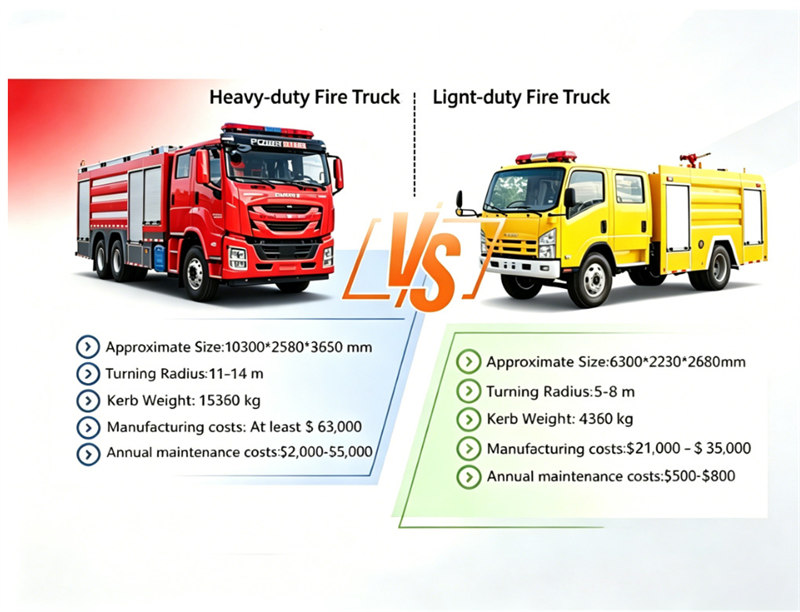
Trak penyelamat kebakaranKeperluan berbeza secara drastik antara kawasan metropolitan dan komuniti luar bandar atau pekan kecil. Jabatan bomba bandar besar bergantung pada trak bomba tugas berat dengan tangki air besar, tangga bertingkat tinggi, dan konfigurasi bertaraf industri penuh untuk menangani kebakaran bangunan tinggi, kebakaran industri, dan kecemasan berskala besar. Namun, bagi bandar kecil, pekan luar bandar, balai bomba kampung, dan jabatan bomba sukarela, trak bomba berat sering menjadi lebih kepada beban berbanding kelebihan. Inilah sebabnya trak bomba ringan telah menjadi penyelesaian arus perdana dan paling praktikal untuk jabatan bomba bandar kecil dan luar bandar di seluruh dunia. Dengan mengimbangi saiz kompak, mobiliti fleksibel, fungsi penyelamatan asas yang lengkap, dan kos keseluruhan yang rendah, ia sangat sesuai dengan keperluan harian penyelamatan dan pencegahan kebakaran pasukan bomba peringkat akar umbi. Trak bomba ringan ialah kenderaan kecemasan kebakaran yang kompak dan ringan, direka khusus untuk senario kebakaran di kawasan akar umbi, pinggir bandar, dan luar bandar. I. Perbandingan antara trak bomba tugas berat dan trak bomba tugas ringan: Untuk melihat dengan jelas jurang antara trak bomba tugas berat dan ringan, kami telah menyediakan carta perbandingan langsung yang merangkumi metrik praktikal utama. Model berat berukuran lebih 10 meter dengan jejari pusingan 11–14m dan berat kerb 15 tan, menelan kos sekurang-kurangnya $63,000 untuk dibina serta $2,000–$5,000 bagi penyelenggaraan tahunan. Sebaliknya, trak bomba ringan kompak mengurangkan dimensi hampir separuh, hanya seberat 4,360 kg, bermula pada harga $21,000, dan mengekalkan penyelenggaraan tahunan di bawah $800, memberikan mobiliti dan nilai bajet yang jauh lebih baik untuk balai bomba luar bandar & pekan kecil. Ⅱ.Sorotan utama trak bomba ringan: 1.Reka bentuk ringan namun berkapasiti muatan tinggi. Berat kasar keseluruhan kenderaan kekal di bawah 8,000 kg walaupun dimuatkan sepenuhnya, membolehkan tindak balas kecemasan yang sangat pantas. 2.Penyesuaian pacuan empat roda tersedia untuk menangani permukaan jalan kasar dan tidak rata yang biasa terdapat di kawasan terpencil. 3.Fungsi pemadaman kebakaran menyeluruh dikekalkan sepenuhnya: a. Tangki berkembar bebas untuk air dan buih pemadam kebakaran. b. Kabin kru dua baris untuk menempatkan pasukan penuh anggota bomba yang bertindak balas. c. Inventori standard lengkap peralatan penyelamatan kecemasan dan pemadaman kebakaran. d. Tambahan pilihan termasuk sistem pencahayaan lokasi kejadian dan peralatan tunda. 4.Sistem power take-off (PTO) berfungsi sebagai pemacu operasi teras. Ia mempunyai kawalan intuitif serta penyelenggaraan dan penggantian komponen yang mudah. Komponen teras tahan lasak mengurangkan perbelanjaan operasi kecemasan jangka panjang untuk jabatan bomba luar bandar dan kawasan perbandaran dengan ketara. Ⅲ.Model trak bomba tugas ringan yang paling popular adal...
Perincian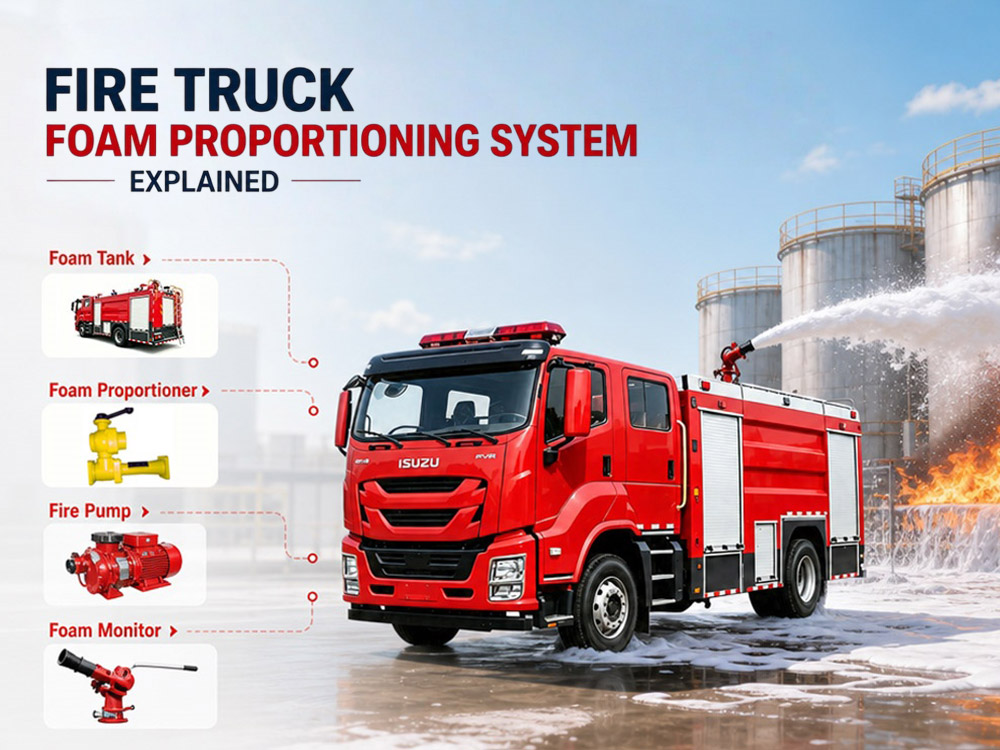
Sistem buih trak bomba mencampurkan air dengan pekat buih pada nisbah tepat (1%, 3% atau 6%) untuk menghasilkan larutan buih. Larutan ini kemudiannya diberi tekanan oleh pam bomba dan dikembangkan dengan udara melalui muncung buih — ini ialah prinsip kerja teras tentang bagaimana sebuah trak bomba buih mencampurkan buih dan air — akhirnya menghasilkan lapisan buih stabil yang menutupi permukaan bahan api. Proses ini meningkatkan kecekapan pemadaman kebakaran lebih 50% sambil mengurangkan pembaziran pekat buih sebanyak 30%. » I. Mengapa Trak Bomba Memerlukan Sistem Buih? Berbanding menggunakan air sahaja, buih menawarkan tiga kelebihan utama: 1. Pengasingan Oksigen— Buih menutupi permukaan yang terbakar, membentuk penghalang fizikal padat yang menghalang oksigen daripada mencapai zon pembakaran, sekali gus memadamkan api. 2. Pengurangan Suhu— Kandungan air dalam larutan buih menyerap sejumlah besar haba apabila menyejat, lalu mengurangkan suhu kawasan terbakar dengan cepat. 3. Pencegahan Penyalaan Semula— Lapisan buih terus menutupi kawasan kebakaran walaupun selepas pemadaman, berkesan mengasingkan oksigen dan wap mudah terbakar, serta mengurangkan risiko penyalaan semula dengan ketara. » II. Prinsip Kerja Teras Sistem Buih 1. Sistem Pembahagian Nisbah:Air mengalir melalui pembahagi nisbah → menghasilkan tekanan negatif (sistem tekanan negatif) atau menggunakan pam buih (sistem tekanan positif) → menarik pekat buih dari tangki buih → mencampurkan pada nisbah pratetap (1%, 3% atau 6%) → larutan buih mengalir ke pam. 2. Pemberian Tekanan Pam:Larutan buih memasuki pam empar → diberi tekanan kepada 0.8–1.2 MPa → dihantar melalui paip ke saluran keluar atau monitor buih. 3. Pengembangan Buih:Larutan buih bertekanan melalui muncung buih atau peranti pengudaraan → udara diserap masuk → larutan mengembang menjadi buih siap → menutupi permukaan bahan api → memutuskan oksigen dan memadamkan api. Konsep Utama: Pekat buih + air tidak sama dengan buih siap. Larutan buih campuran masih merupakan cecair — ia mesti digabungkan dengan udara melalui muncung buih untuk menjadi buih pemadaman kebakaran sebenar. Apabila larutan buih bertekanan tinggi melalui muncung pada kelajuan tinggi, ia menghasilkan zon tekanan negatif setempat yang menarik masuk udara secara paksa. Udara dan cecair berlanggar serta terpotong dengan kuat di dalam muncung, lalu terurai serta-merta menjadi berjuta-juta gelembung kecil yang terkumpul membentuk buih putih. » III. Bagaimanakah Trak Bomba Mencampurkan Buih dan Air? Proses pencampuran buih pada trak bomba terdiri daripada empat langkah utama, daripada bekalan air hingga pembentukan buih akhir. Langkah 1: Pam Bomba Membekalkan Aliran Air Selepas trak bomba dihidupkan, pam bomba membekalkan kuasa untuk sistem buih. Sumber air boleh termasuk tangki terbina dalam, pili bomba, sungai, tasik atau takungan. Pam bomba bertanggungjawab membina tekanan air, menyediakan aliran stabil dan menolak air ke dalam sistem pembahagian nisbah buih. Langkah...
Perincian
Sila baca selanjutnya, terus berhubung, langgan, dan kami mengalu-alukan anda untuk berkongsi pendapat anda.

 Rangkaian IPv6 disokong

 Melayu
 English
 français
 Deutsch
 русский
 italiano
 español
 português
 Nederlands
 العربية
 日本語
日本語 한국의
한국의 Türkçe
 ไทย
ไทย Tiếng Việt
 Indonesia
  中文
中文 қазақ
қазақ Filipino
 မြန်မာ
 српски